
Your Proprietary Data Shouldn't Train Someone Else's Model.
Fine-tuned open-weights AI, operated on infrastructure you govern. From rented GPUs to right-sized on-prem, one partner across the whole path.
Engineered on the enterprise stack IVI already runs




-1-1-1.png)
The Hidden Cost of API Convenience
Every fine-tuning job, every embedding call, every prompt with customer data in it passes through someone else's infrastructure, on someone else's terms. Frontier API vendors built genuinely useful products. They also built a business model where your most valuable data helps train a model you'll never own, running on hardware you'll never control, priced on a meter you don't set.
Open Source Models
Open-weight models, Llama, Mistral, Qwen, and their fine-tuned descendants, have closed most of the capability gap that used to justify an API-only strategy. Fine-tuned on your data, they routinely match or beat general-purpose frontier models on the narrow, high-volume tasks that actually run your business. The question isn't whether an open model is 'as good' as a frontier model in the abstract. It's whether a model fine-tuned on your support tickets, your claims data, or your contracts outperforms a generic one on the ten tasks you run a million times a month. Usually, it does.
Where frontier APIs still lead
- •General-purpose reasoning on novel tasks
- •Low-volume, low-sensitivity workloads
- •Commodity content generation
- •Experimentation and prototyping
Where private models pull ahead
- ✓Tasks fine-tuned on your proprietary data
- ✓High-volume production workloads
- ✓Data-sovereign or regulated environments
- ✓Predictable, controllable economics
The Barrier is Infrastructure
If the model gap has closed, why isn't everyone running private AI? Because the model was never the hard part. Standing up GPU infrastructure, securing it, operating it, and sizing it correctly is real engineering work, and most teams don't have a rented-to-owned playbook that avoids overbuilding on day one or underbuilding by month six. The numbers below are what it actually takes to get from a standing start to a right-sized, owned environment.
Rent, Baseline, Own
Rent first. Run production workloads on rented GPU capacity from day one, and let six months of real telemetry tell you what to build, not a sizing spreadsheet. Baseline against actual utilization, cost per workload, and growth trajectory. Then build to the evidence. On-prem or colocation sizing decisions get made against your own data, not a vendor's benchmark. The rented environment keeps running until the owned one is proven, so there's no cutover risk and no gap in production.
The Aegis Private AI journey
Infrastructure evolves. Your operational relationship doesn't.
Is Aegis Private AI the right fit for you?
45-minutes with an IVI solution architect. No slideware, just an informative conversation.
Get a Readiness Assessment →What Complete Control Means
Control isn't a compliance checkbox. It's the difference between a vendor relationship and infrastructure you actually own. Four things have to be true for that to hold up under scrutiny, not just under a sales pitch. And a policy-driven AI gateway sits in front of all of it, routing each request to your private cluster or a public model by rule, so sensitive work never leaves your control.
Dedicated GPU Compute
Never shared, never multi-tenant. Isolated from provisioning through steady state.
Customer-Managed Keys
Encryption keys in your KMS. Data can remain in your object storage. Your governance boundary.
Full Weight Custody
You own model weights and the pipeline. Take them with you if you leave.
US-Only Residency
Compute and data stay in US regions. Private network paths via VPN or Direct Connect.
How the Engagement Works
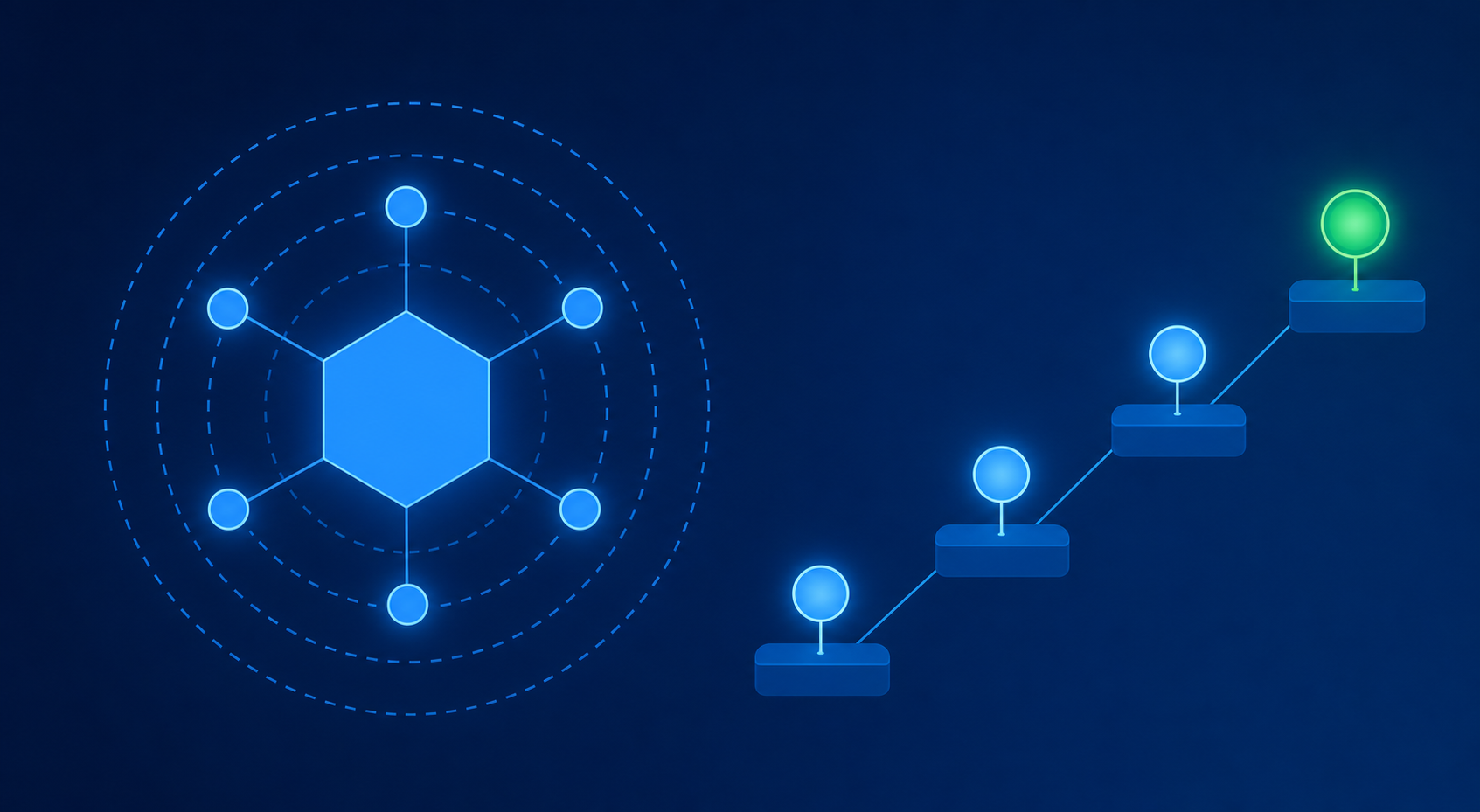
Four stages, one team, from first conversation to steady-state operations. No handoff between the people who scoped it and the people who run it.
-
01
Assess
Readiness assessment. Workload triage. Data sensitivity scoring. Sizing framework.
-
02
Deploy
Environment provisioning at the rented GPU provider. Base model selection. Initial fine-tune. Production cutover.
-
03
Baseline
Six months of live workload telemetry via Aegis PM. Utilization curves, cost per workload, growth trajectory.
-
04
Migrate
On-prem cluster design against baseline. Colocation buildout. Controlled workload cutover. No production disruption.
Is This the Right Fit?
Private AI isn't the right call for every team, and we'd rather tell you that in the first conversation than the sixth month. Here's how we think about fit.
- ✓You spend $15K+ per month on frontier APIs touching proprietary data
- ✓Your differentiation lives in your data, processes, or domain knowledge
- ✓Executive alignment on private AI as a strategic direction
- ✓You don't want to hire an ML platform team to get there
- −API spend under $8K per month with no sovereignty driver
- −Exploring, not committing to production AI
- −Workloads are commodity and well-served by APIs
Continue reading · The private AI series
Your competitive moat is training someone else's model
Why crown-jewel data doesn't belong on shared frontier infrastructure.
The right sequence for building private AI infrastructure
Rent, baseline, own: size for evidence, not estimates.
What GPU compute actually costs
Hyperscalers, specialty providers, and API spend, compared honestly.
Last reviewed July 07, 2026 · Next review September 30, 2026 · Content owner IVI