
Telephony and Routing Optimization
Identify and eliminate waste across phone numbers, routing logic, and call flows.
- DID inventory and utilization review
- Routing and call flow efficiency analysis
- Regional and usage alignment
Amazon Connect Cost Optimization
Gain visibility into telephony, AI, and workflow costs across Amazon Connect and supporting AWS services, and reduce wasted spend with a structured FinOps approach
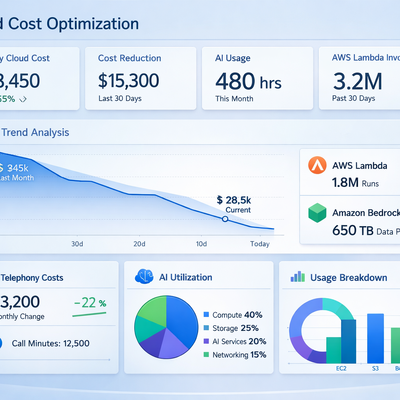
Amazon Connect FinOps helps organizations understand where contact center spend is coming from, why it is increasing, and how to optimize it without impacting customer experience. This includes telephony, routing, AI usage, and connected AWS services such as Amazon Bedrock and AWS Lambda.
.png)
.png)
.png)
.png)

Legacy and cloud contact center platforms provide flexibility, but costs can grow quickly without clear visibility. Telephony inventory expands, routing becomes inefficient, AI interactions increase, and backend services like Lambda and Bedrock generate usage that is not always tracked or optimized.
Many organizations also lack clarity on the right Amazon Connect licensing model, whether traditional consumption or Unlimited AI pricing, and how that choice impacts overall cost.
We deliver a structured Amazon Connect FinOps review that analyzes usage patterns across telephony, routing, AI interactions, and supporting AWS services. This includes evaluating licensing models, identifying cost drivers, and building a practical roadmap to reduce waste while maintaining or improving customer experience.
Amazon Connect and AWS consumption-based services provide flexibility, but costs can increase quickly when usage is not actively managed. Telephony sprawl, inefficient routing, unnecessary AI interactions, and backend services like Lambda and Bedrock often scale without clear ownership or visibility.
Many organizations also select a pricing model without fully understanding how usage patterns will impact cost. As AI adoption increases, this becomes even more complex, with costs distributed across multiple services rather than a single platform.
Intelligent Visibility delivers a structured FinOps engagement designed specifically for customer service environments. We analyze how telephony, routing, AI interactions, and supporting AWS services contribute to cost, then identify where spend can be reduced without impacting customer experience.
This includes evaluating the right Amazon Connect licensing approach, whether traditional consumption-based pricing or Unlimited AI, and aligning that decision with actual usage patterns. We also assess connected AWS services such as Bedrock and Lambda to ensure total cost is understood and optimized across the full customer service stack.
Identify and eliminate waste across phone numbers, routing logic, and call flows.
Optimize how AI services are used to ensure cost aligns with value delivered.
Understand how backend services contribute to overall CX cost.
Ensure your Amazon Connect pricing model matches how your environment actually operates.
We follow a structured approach that combines technical analysis with financial insight to identify cost drivers and define a clear optimization path.
Review telephony, routing, AI interactions, and AWS services such as Lambda and Bedrock to understand where costs originate.
Isolate inefficiencies across telephony, automation, AI usage, and backend workflows, including misaligned pricing models.
Build a prioritized plan with immediate savings opportunities and longer-term improvements aligned to CX goals.
This engagement is designed for organizations that want to improve cost visibility and control as their Amazon Connect and AI usage grows.
The right FinOps approach depends on your current environment, cost challenges, and whether you are optimizing or transforming your contact center strategy.
Improve cost visibility and reduce waste across telephony, AI usage, and AWS services without changing your core platform.
Organizations that want immediate savings and better cost control while continuing to operate their current Amazon Connect environment.
Focused on optimization rather than full transformation. Does not address deeper architectural limitations.
Start here in most environments. Intelligent Visibility recommends identifying high-cost areas such as telephony sprawl, AI overuse, and backend consumption before making larger changes.
Align pricing models, workflows, and architecture to support scalable and predictable cost as AI and automation usage grows
Organizations evaluating Traditional vs Unlimited AI pricing or experiencing rapid growth in AI-driven interactions.
Requires more planning and coordination. May involve changes to workflows, pricing model, or architecture.
Best when cost challenges are tied to growth, AI adoption, or misaligned pricing structures. Evaluate licensing decisions alongside workflow and automation strategy.
These examples show how cost drivers appear in real environments and how targeted FinOps actions reduce spend while improving operational clarity.
Telephony costs often grow unnoticed as environments scale. Unused numbers, legacy routing paths, and regional overprovisioning can create ongoing monthly waste.
An organization has accumulated hundreds or thousands of DIDs across multiple regions. Many are unused, duplicated, or tied to outdated routing flows, but continue to incur recurring charges.
Reduced recurring telephony costs, simplified routing architecture, and improved visibility into number usage.
Intelligent Visibility combines telephony expertise with AWS cost analysis to identify inefficiencies that are often missed in standard billing reviews.
AI-driven interactions can scale rapidly, especially when Lex bots or Bedrock-powered workflows are triggered unnecessarily or inefficiently.
Bot interactions are triggered for low-value use cases or duplicate workflows, increasing cost per interaction without improving customer outcomes.
Lower AI-related costs while maintaining or improving automation effectiveness and customer experience.
IVI focuses on aligning AI usage with business outcomes, ensuring automation delivers measurable value rather than uncontrolled consumption.
Backend services like Lambda often generate hidden costs when triggered excessively or when workflows are not optimized.
High-volume contact flows trigger Lambda functions multiple times per interaction, or duplicate logic exists across flows, increasing compute usage unnecessarily.
Reduced backend service costs and improved performance of customer service workflows.
VI understands how contact center workflows drive AWS consumption and optimizes both together, not in isolation.
Selecting the wrong Amazon Connect pricing model can significantly increase costs, especially as AI usage grows.
An organization adopts AI-driven workflows without reevaluating whether traditional consumption pricing or Unlimited AI licensing is more cost-effective.
Improved cost predictability and alignment between usage patterns and pricing model.
IVI combines technical and financial analysis to guide licensing decisions, ensuring pricing strategy matches real-world usage and growth.
Please complete this form and a member of our team will be in touch.
Amazon Connect FinOps is the practice of improving financial visibility and cost control across Amazon Connect and the AWS services that support it. This includes telephony, routing, AI interactions, automation, and backend services such as Lambda and Bedrock. Intelligent Visibility delivers Amazon Connect FinOps reviews to help organizations understand cost drivers and reduce waste without negatively affecting customer experience.
A FinOps review can include Amazon Connect licensing and usage, telephony and DID inventory, routing and flow design, AI services such as Lex and Bedrock, Lambda usage, and other AWS services tied to customer service workflows. The goal is to understand the full cost of operating the contact center, not just the core platform charges.
Yes. Part of the review is evaluating whether your current usage patterns align better with traditional consumption-based pricing or Unlimited AI. Intelligent Visibility looks at interaction volume, AI usage, workflow patterns, and supporting AWS consumption to help determine which model is more cost-effective for your environment.
It includes more than just Amazon Connect charges. We review the connected AWS services that contribute to customer service cost, including Amazon Bedrock, AWS Lambda, and other workflow-related services. This is important because AI and automation costs are often distributed across multiple AWS services rather than appearing in one place.
Telephony costs often increase because of unused or underutilized DIDs, legacy routing paths, unnecessary number sprawl across regions, or configurations that no longer match current demand. These issues can continue generating recurring charges even when they no longer support an active business need.
AI costs can increase when bot flows are triggered too often, used for low-value interactions, or designed inefficiently. In some environments, Lex or Bedrock usage grows without clear visibility into which interactions are actually delivering value. A FinOps review helps identify where AI usage is productive and where it is simply increasing spend.
It should not. The goal is to reduce waste and improve alignment between cost and business value, not to remove capabilities that customers rely on. Intelligent Visibility focuses on identifying unnecessary spend while preserving or improving the customer experience.
Common findings include unused phone numbers, inefficient routing, excessive bot or AI usage, unnecessary Lambda invocations, weak tagging and allocation practices, and pricing models that no longer fit actual usage patterns. The exact opportunities vary by environment, but most organizations have a combination of quick wins and longer-term optimization opportunities.
The timeline depends on the size and complexity of the environment, but most reviews can be completed in a relatively short engagement once access to usage, billing, and architectural information is available. The output is designed to help organizations act quickly on the highest-value optimization opportunities.
Typical deliverables include a current-state usage and spend analysis, telephony and AI cost review, pricing model evaluation, cost allocation recommendations, and a prioritized roadmap for both immediate savings and longer-term cost control improvements.
No. It is useful for both growing and mature environments. Smaller environments benefit from establishing better cost discipline early, while larger environments often benefit from uncovering waste that has accumulated over time across telephony, AI, and backend services.
If your Connect and related Lambda, S3, and Bedrock spend routinely exceed $5,000/mo. this service is a fit.
A standard AWS cost review may identify broad usage patterns, but it often does not account for the operational realities of customer service platforms. Intelligent Visibility brings CX, telephony, automation, and Amazon Connect expertise into the FinOps process, which helps identify cost drivers specific to contact center environments.